




Pipe pliers are a common hand tool mainly used to clamp pipes or fittings for disassembly, repair or installation. Different types of pipes and fittings may require different models of pipe wrench. Here are some common pipe wrench models:
1. Straight-mouth pipe wrench: Also known as ordinary pipe wrench, it is a common pipe tool suitable for clamping round pipes and pipe fittings. Its clamping mouth is straight and can clamp pipes of different sizes.
2. Bayonet type pipe wrench: also called barb type pipe wrench, suitable for clamping irregularly shaped pipes and fittings. Its clamping mouth is a V-shaped barb that can clamp the raised part of the pipe.
3. Elbow type pipe pliers: suitable for clamping curved pipes and fittings. Its clamping mouth is curved to adapt to the curved shape of the pipe.
4. Wrench-type pipe pliers: Also called pipe wrenches, they can clamp pipes and threaded joints, and can both clamp and rotate. Its clamp is shaped like a wrench and can rotate pipes and joints in different directions.
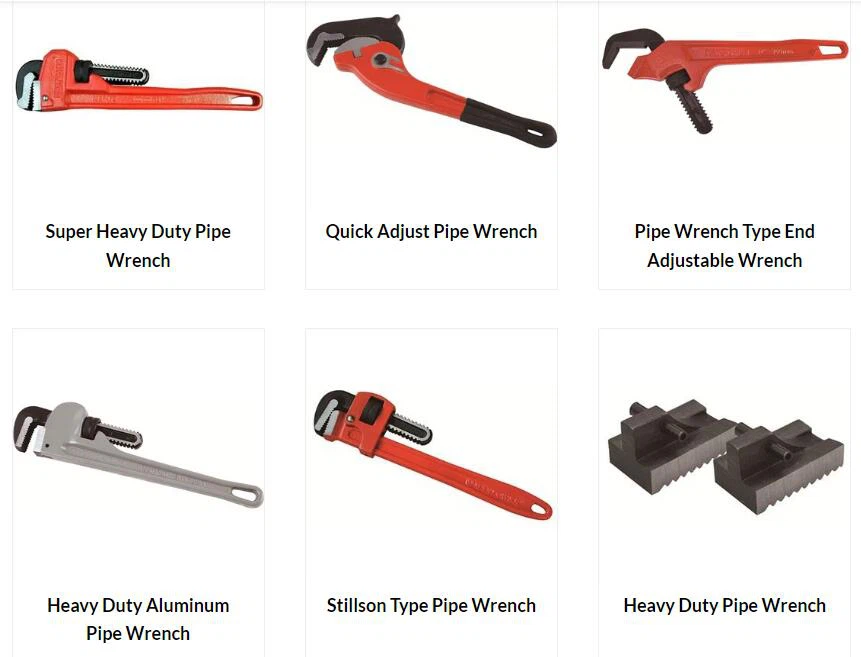
The use of a pipe wrench is more convenient, but if it is not enough, you must also pay attention to the details to avoid unnecessary trouble.
What are the specifications, models and sizes of pipe wrenches?
1. What are the specifications, models and sizes of pipe wrenches?
Pipe wrench wrenches are available in metric and imperial systems. Pipe wrench wrenches of different sizes have different usage ranges and methods, as follows:
1. If divided according to the metric system, the common specifications and models are 15.0 cm, 20.0 cm, 25.0 cm, 30.0 cm, 35.0 cm, 45.0 cm, 60.0 cm, 90.0 cm, and 120.0 cm.
2. If divided according to the imperial system, the common specifications and models are 6 inches, 8 inches, 10 inches, 12 inches, 14 inches, 18 inches, 24 inches, 36 inches, and 48 inches.

What details should you pay attention to when choosing a pipe wrench?
1. When choosing a pipe wrench, you should choose the appropriate size according to actual needs. This will make it more convenient to use and prevent loosening when tightening the accessories. Moreover, the opening of the pipe wrench used is slightly larger than the diameter of the workpiece, so as not to affect later use.

2. When using a pipe wrench, wait until the pliers clamp the workpiece tightly, and then press the wrench firmly to secure the workpiece. In addition, when fixing the pipe wrench, avoid slipping.
3. If you need to use a force rod, you must ensure that the length is within the closing range. When using it, do not use too much force to avoid exceeding the strength range that the pipe wrench wrench can withstand.4. When using a pipe wrench, you also need to check whether the fixing pin is firmly fixed, and ensure that there is no cracking in the position of the clamp head and clamp handle. If any abnormality is found, try not to use it to avoid safety hazards.
5. If you use a relatively small pipe wrench, you need to control the strength and do not use too much force. Also try not to use the pipe wrench as a hammer to avoid unnecessary damage. After use, the pipe wrench needs to be cleaned and greased on the surface.


