








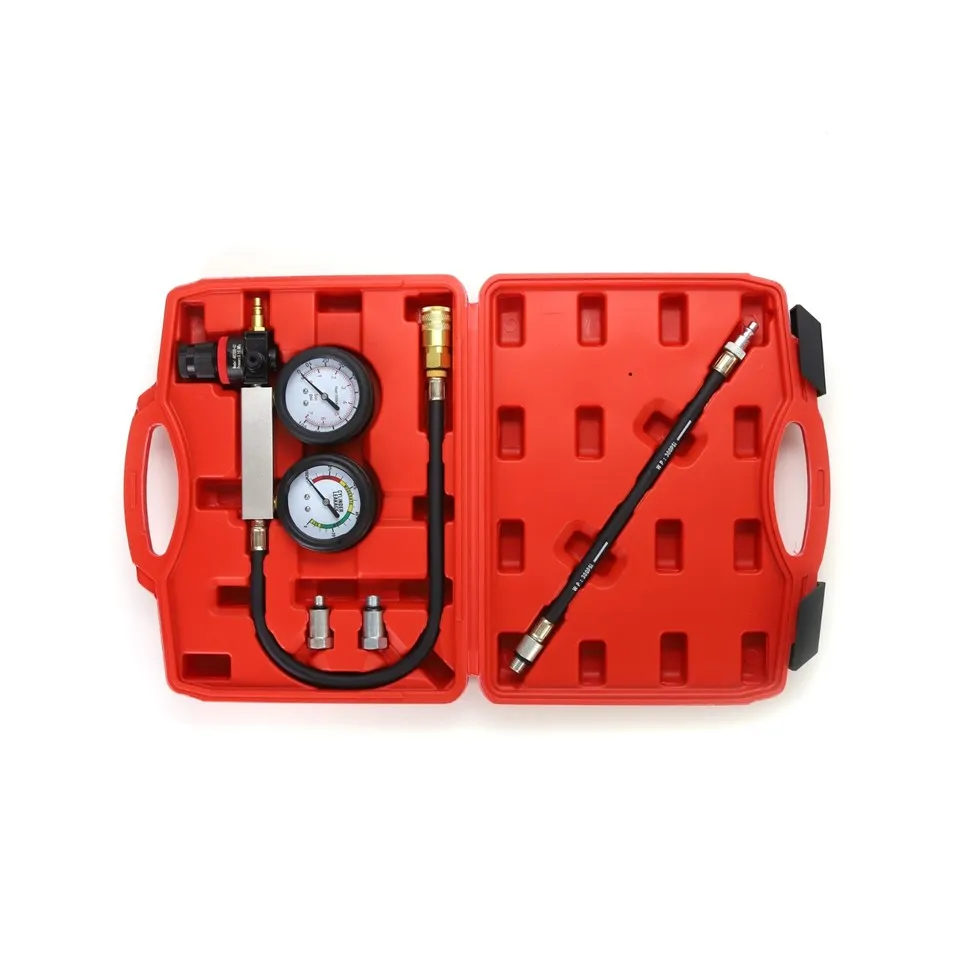
Cylinder Leak Detector Engine Cylinder Side Leak Tool Leak Detector Pressure Gauge Automobile Tester
High industrial quality Cylinder leak detector Engine cylinder side leak tool leak detector Pressure gauge Automobile tester to help optimize and solve problems.
Item No:MP73055
1. Essence and working principle of the instrument
Cylinder leak detector is a professional tool used to test the tightness of engine cylinders. By filling compressed air into the cylinders, monitoring pressure attenuation and leak locations, and judging the sealing performance of cylinders, piston rings, valves and other components. Its core principles are:
Pressure input: Inject high-pressure air into the cylinder through an air compressor or air source (usually 0.6-1.0MPa, simulating the compression pressure of the cylinder);
Leakage monitoring: Pressure changes are displayed in real time through a pressure gauge. If the pressure drops rapidly (exceeds the standard value), there is a leak;
Leak location: Determine the leak location through a stethoscope or observing the leak location (such as bubbling in the water tank or venting from the exhaust pipe).
2. Core role and application scenarios
1. Engine fault diagnosis: accurate detection of tightness
Check for abnormal cylinder compression pressure:
When the engine suffers from power drop, difficulty in starting, or low cylinder pressure test results, use a leak detector to further locate the cause of the leak (such as worn piston rings, scratched cylinder walls, and loose valve seals).
Case: The cylinder pressure test of a certain vehicle showed that the pressure of cylinder 1 was 20% lower than the standard value. The leak detector found that the pressure of the cylinder dropped from 0.8MPa to 0.5MPa within 30 seconds, and bubbles appeared at the water tank opening. It was judged that the cylinder gasket was damaged and the coolant channel leaked.
Evaluation of piston ring and cylinder wall sealing:
Check the wear degree of piston rings (for example, when the engine burns oil, the leak detector shows that the cylinder pressure attenuation exceeds 15%, and the crankcase vent leaks significantly).
2. Valve and valve seat sealing performance testing
Quality verification after valve grinding:
After repairing the valve or valve seat, use a leak detector to test the sealing performance (the standard is pressure attenuation ≤5% within 30 seconds) to avoid engine power reduction or abnormal sound caused by poor sealing.
Judgment of valve oil seal leakage:
If there is a clear leak sound in the intake manifold or exhaust pipe during leak testing, it may be due to aging of the valve oil seal or wearing of the valve stem, causing air to leak from the valve clearance.
3. Test for tightness of cylinder gasket and cylinder block
Cylinder gasket damage positioning:
If the coolant expansion pot bubbles or the engine oil is emulsified during leak testing, it means that the cylinder gasket is damaged and the cylinder is connected to the water channel/oil channel; if the exhaust pipe discharges a large amount of white smoke, the cylinder gasket may leak into the combustion chamber.
Cylinder block crack detection:
After charging the cylinder, if bubbles emerge from the outside of the cylinder block (such as the junction between the cylinder liner and the cylinder block), it can be determined that there is a crack or sand hole in the cylinder block.
4. Engine performance evaluation before and after overhaul
Fault location before overhaul:
Before engine overhaul, use a leak detector to determine the parts (such as piston rings, valves, cylinder gaskets) that need to be replaced to avoid blind disassembly.
Quality verification after overhaul:
After overhaul and assembly, use a leak detector to test the tightness of each cylinder (pressure attenuation ≤3% is good) to ensure that the maintenance quality meets the standard (for example, racing engines require higher tightness, and the attenuation needs to be ≤1%).
5. Commercial vehicles and construction machinery engine maintenance
Heavy diesel engine testing:
Inspect multi-cylinder engines (such as 6-cylinder, 12-cylinder) of trucks, excavators and other equipment, quickly locate leaking cylinders, and reduce downtime (such as port crane engine troubleshooting).
Ship engine maintenance:
In the maintenance of marine diesel engines, leak detectors can assist in testing the tightness of cylinder liners and piston assemblies to avoid insufficient power or excessive emissions due to leaks.
3. Usage process and precautions
Test preparation:
Warm the engine to normal temperature (80-90℃), remove the spark plug/injector, and turn the piston to compression top dead center (ensure the valve is closed);
Connect the leak detector air tube to the cylinder, ensuring that the interface is sealed (e.g. using a tapered rubber plug or threaded interface).
Operation steps:
Charge 0.8MPa compressed air into the cylinder and close the air source valve;
Observe the pressure gauge for 30 seconds, record the pressure attenuation value, and use a stethoscope to monitor the source of the leak sound (such as water tank, exhaust pipe, oil filler).
Safety and Maintenance:
Keep away from rotating parts (such as fans) during testing, and the air source pressure shall not exceed 1.0MPa to avoid damaging cylinder parts;
Clean up the oil stains in the trachea after use, and calibrate the pressure gauge regularly (once a year) to ensure accurate data.


Our Service
One-stop tool solutions- OEM Business and Our Own Brand development Basing on more than 54-year professional production and sales experience, expertise and commitment in delivering professional quality service to world-wide customer base, Maxpower is your reliable partner always!
Skilled Sales Team and Expert Team
Maxpower skilled sales team has undergone Industrial's technical training and business experience. We will definitely provide professional service to respond customers' demands.
Expert Team, Technical Support
We have established two teams of production and engineering technology to coordinate all resources to achieve enterprise innovation and build a smart manufacturing factory. Our vision is to grow with end customers, achieve long-term operations, create one-stop tool solutions for customers, and create new value-added highlights for customers in accordance with lean thinking.
Previous
Automobile Battery TesterYou Might Also Like



Send Inquiry