







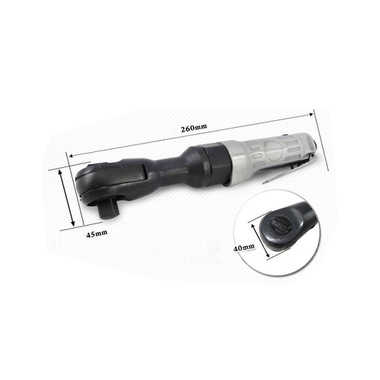
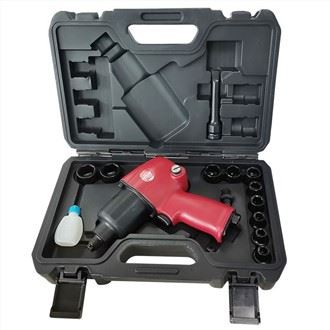
Heavy Duty Pneumatic Ratchet Wrench
High industrial quality Heavy duty pneumatic ratchet wrench to help optimize and solve problems.
Item No:MP09803
1. The core role and application scenarios of heavy pneumatic ratchet wrenches
The heavy-duty pneumatic ratchet wrench is a high-torque tightening tool powered by compressed air. Its "heavy-duty" characteristics are reflected in large torque output (usually 500-3000N·m) and durable structural design. It is mainly used for rapid disassembly and assembly of high-strength bolts., suitable for the following scenarios:
1. Heavy machinery manufacturing and maintenance
Engineering machinery assembly:
Tighten chassis bolts, engine block bolts, and hydraulic system connections of excavators, cranes, loaders and other equipment to ensure connection reliability under heavy load conditions.
Remove rusty or stuck bolts caused by vibration in mining machinery (such as crushers and boring machines) to improve maintenance efficiency.
Agricultural machinery maintenance:
Handle high-strength bolts (such as M24-M36 specifications) for gearboxes, drive shafts and other components of large tractors and combine harvesters to adapt to frequent maintenance needs after field operations.
2. field of transportation
Truck and bus repair:
Quickly disassemble and disassemble truck hub nuts, drive axle bolts, and engine bracket bolts (torque requirements can reach more than 1000N·m), which is especially suitable for efficient maintenance of logistics fleets.
Ships and railway equipment:
Bolting of ship deck equipment (such as windmills and winches), or maintenance of railway locomotive wheels and coupler components, should be used in wet and high-vibration environments.
3. Energy and infrastructure projects
Wind power and nuclear power equipment:
Tighten the flange bolts of the wind turbine tower and the pressure vessel connections of nuclear power equipment to meet the requirements of high-precision torque control (some models support torque preset).
Bridge and steel structure construction:
When installing large bridge supports, high-voltage transmission towers, and oil platform steel structures, quickly tighten high-strength bolts (such as levels 10.9 and 12.9) to ensure structural safety.
4. industry equipment installation
Heavy machine tools and production lines:
Fixing machine tool bases, assembling large gearboxes, and bolting of production line conveying equipment meet the batch operation needs of factory floors.
Petrochemical pipelines:
The disassembly and assembly of flange bolts of high-pressure pipelines, especially in explosion-proof environments (pneumatic tools have no spark), ensures operation safety.
2. Advantages of heavy pneumatic ratchet wrenches
High torque output: Easily respond to the pre-tightening force requirements of large-diameter bolts and avoid loose connections caused by insufficient torque of manual tools;
Two-way ratchet design: It is convenient to switch between positive and negative turns, without repeatedly adjusting the wrench angle, suitable for operation in narrow spaces (such as bolts at the bottom of the equipment);
Efficiency and durability:
Pneumatic power can operate sustainably, is lighter than hydraulic wrenches, and is more adaptable to harsh environments (such as dust, humidity) than electric wrenches;
The metal gearbox and high-strength shell design have strong impact resistance and are suitable for long-term use under heavy load conditions.
3. Usage methods and operating steps
1. preparations
Tools and accessories inspection:
Confirm the air pressure of the air source (usually 8 - 10 bar), connect the pressure-resistant air pipe (diameter ≥ 10 mm), and check the tightness of the quick joint;
Select a matching sleeve based on the bolt size (square head drive size is usually 3/4,"1," or 1 - 1/2 ") to ensure that the sleeve fits completely into the bolt head without loosening.
Torque setting (if there is adjustment function):
Some heavy-duty wrenches support torque adjustment, and the target torque is preset through a knob or dial (refer to the bolt specification, for example, the recommended torque for M24 bolts is about 800 - 1200 N·m).
Security protection:
Wear anti-smash gloves, goggles, and non-slip shoes; if working at high places, fix tools to prevent falling;
Ensure that the workpiece is fixed firmly (e.g. lifting heavy parts with a crane) to avoid the workpiece being displaced when the wrench is exerting force.
2. Start-up and operating specifications
Starting steps:
Turn on the air supply switch, gently press the trigger of the wrench, and let the ratchet wheel idle for 1 - 2 seconds to confirm that the operation is normal;
Put the sleeve around the head of the bolt, keep the wrench perpendicular to the bolt, and slowly press the trigger to apply torque (to avoid sudden force causing the bolt to slip).
Tightening operation skills:
Adopt the "cross tightening method"(such as flange bolts in diagonal order) to gradually achieve the target torque in 2 - 3 times to ensure uniform force;
When the wrench makes a "click" sound or the speed drops significantly, it means that the preset torque is close to (if there is no adjustment function, it needs to be re-checked by hand feeling or torque wrench).
Dismantling operation skills:
First tap the head of the bolt to remove the rust, and then use a wrench to slowly apply reverse torque; if the bolt becomes stuck, spray rust remover first to avoid forced disassembly and causing the bolt to break.
3. Downtime and maintenance
Stopping steps:
After the operation is completed, turn off the air supply switch. After the ratchet wheel completely stops rotating, remove the sleeve and disconnect the air pipe.
Daily maintenance:
After each use, inject 5 - 10 drops of special lubricating oil for pneumatic tools from the air inlet and idle for 10 seconds to lubricate the internal ratchet and gear;
Regularly clean the metal debris at the sleeve interface and check whether the air pipe is aging and cracked;
During long-term storage, apply anti-rust oil to metal parts to avoid corrosion caused by humid environment.
4. Safety precautions
Illegal operations are prohibited:
It is strictly prohibited to use worn or mismatched sleeves (such as forcibly tightening 1 - 1/2 "bolts with a 1" sleeve) to avoid cracking and splashing of the sleeve;
Do not use a wrench to hit the workpiece, or add torque to the wrench handle (which may cause overload and damage to the internal gear).
Air source and load safety:
Ensure that the air compressor displacement matches the wrench requirements (for example, large torque wrenches need to have a displacement of ≥ 0.3m ³/min) to avoid torque attenuation caused by insufficient air pressure;
Stand firm during work and hold the wrench tightly with both hands to prevent hand sprains caused by high torque reactions.

Our Service
One-stop tool solutions- OEM Business and Our Own Brand development Basing on more than 54-year professional production and sales experience, expertise and commitment in delivering professional quality service to world-wide customer base, Maxpower is your reliable partner always!
Skilled Sales Team and Expert Team
Maxpower skilled sales team has undergone Industrial's technical training and business experience. We will definitely provide professional service to respond customers' demands.
Expert Team, Technical Support
We have established two teams of production and engineering technology to coordinate all resources to achieve enterprise innovation and build a smart manufacturing factory. Our vision is to grow with end customers, achieve long-term operations, create one-stop tool solutions for customers, and create new value-added highlights for customers in accordance with lean thinking.
You Might Also Like


Send Inquiry