






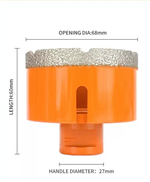

Alloy Hole Opener 38mm
High industrial quality Alloy hole opener 38mm to help optimize and solve problems.
Item No:W59930
1.Structural and material advantages
Core design: It is usually composed of an alloy cutter head (serrated or annular), a centrally positioned drill and a metal substrate. The annular cutter head forms a hollow structure around the central drill. When drilling, it only cuts the edge of the material to reduce waste and friction.
Alloy characteristics: The hardness of cemented carbide tips can reach *-92HRC, far exceeding that of high-speed steel. They are suitable for processing high-hardness materials, have excellent wear resistance and long service life.
2.Applicable materials and processing scenarios
metal material processing
Steel plates and pipes:
Drilling holes with a diameter of 12-120mm (such as ventilation holes, pipe connection holes) in steel plates, stainless steel plates, and aluminum alloy plates with a thickness of 2-10mm is common in the processing of distribution boxes, ventilation equipment casings, and automobile body parts.
Open side holes in metal pipes (such as steel pipes and copper pipes) for branch connections (such as heating pipes and industrial piping systems).
High hardness metals:
Drilling can be done in hard metals such as hardened steel and cast iron (reducing the speed and using cutting fluid), such as hole machining of machine tool parts and mold templates.
Wood and plastic processing
Deep processing of wood:
Make large round holes (such as slightly mounting holes, round mortise and mortise holes) in solid wood, plywood or density board, and decorative round holes or functional holes used to make tables, chairs, and cabinets in carpentry scenes.
Process hollow holes in wooden handicrafts (such as carved partitions and round decorations) to improve manual production efficiency.
Plastics and composites:
Drill large holes in PVC plates, acrylic plates, FRP and other materials (such as light-transmitting holes in bathroom partitions, pipe holes in model sand tables) to meet ventilation, wiring and other needs.
Building and decoration materials
Walls and plates:
Drill air conditioning pipe holes and wire sleeve holes in gypsum board, fiber cement board, and ceramic tiles (glass drill bits are required), and are used to install range hoods, gas pipes, etc. during decoration.
Drill expansion bolt holes (large diameter sizes) in concrete walls (requiring low-speed operation) to secure heavy supports or equipment.
3.typical application
industrial manufacturing
Machining: Machining mounting holes in metal parts (such as cooling holes in motor end caps, bolt holes in flanges), or making connection holes for piping systems.
Electrical equipment: Open cable inlet holes on distribution cabinets and control boxes, or install screen holes for fans and radiators.
Construction and installation engineering
Hydropower installation: Drill threading holes for water pipes and gas pipes in walls and floors, or install circular pipe interfaces for ventilation systems.
Decoration and decoration: Make ceiling light holes, wall decoration round holes (such as plaster line shaped holes), or drill lock installation holes in door and window frames.
DIY and maintenance
Home renovation: Install round handle holes and drawer slide mounting holes on furniture, or expand holes for old furniture to repair damaged screw holes.
Handmade: Make round openings for wooden storage boxes, breather holes for plastic storage boxes, or DIY decorative hollow patterns on metal plates.
special scene
Car maintenance: Drill modification holes in car bumpers and hood (such as installing spotlights, air filter guides).
Aerospace: Machining high-precision mounting holes on aluminum alloy parts (special equipment required) to meet the connection needs of lightweight structures.
4.precautions for use
Speed and feed:
Metal processing: The speed is controlled at 300-800 RPM, and the feed is constant at low speed to avoid cracking of the cutter head due to high temperature (cutting fluid can be applied to cool down).
Wood/plastic: The speed can be increased to 1000-2000 RPM, but it is necessary to prevent the material from melting or breaking due to too high speed.
Positioning and stability:
Use a central drill to position first to ensure that the hole opener is perpendicular to the material surface to avoid offset; use a bench drill or fixture to fix the material to reduce shaking.
Blade head maintenance:
Clean up residual debris on the cutter head after processing to avoid contact with corrosive substances; if the cutter head is worn, use a special grinding wheel to trim or replace the cutter head with a new one.
Previous
Alloy Hole Opener 45mmYou Might Also Like


Send Inquiry